Full Arch Dental Implants Serving Purcellville & Western Loudoun County
Patient-Centered Care
Full-Arch Rehabilitation
"We provide specialized surgical care physically in Purcellville, bringing peace of mind to western Loudoun families."
Loudoun Valley Oral Surgery
Purcellville, VA Specialist
If you are missing most or all of your teeth, you know how much daily life is affected — eating, speaking, and smiling no longer feel simple. For patients seeking a stable, permanent alternative to dentures, All-on-4 dental implants in Purcellville, VA offered by Loudoun Valley Oral Surgery provide a full-arch restoration designed to look, feel, and function like natural teeth. As part of the Winchester and Merrifield Oral Surgery network, our practice brings group-practice expertise to western Loudoun County, and we perform all treatment planning with advanced 3D CT imaging on-site. Whether you live in Purcellville, Round Hill, or Hillsboro, you no longer need to travel to Leesburg or Winchester for high-quality implant care.
Implant Innovation
What Are All-on-4 Dental Implants?
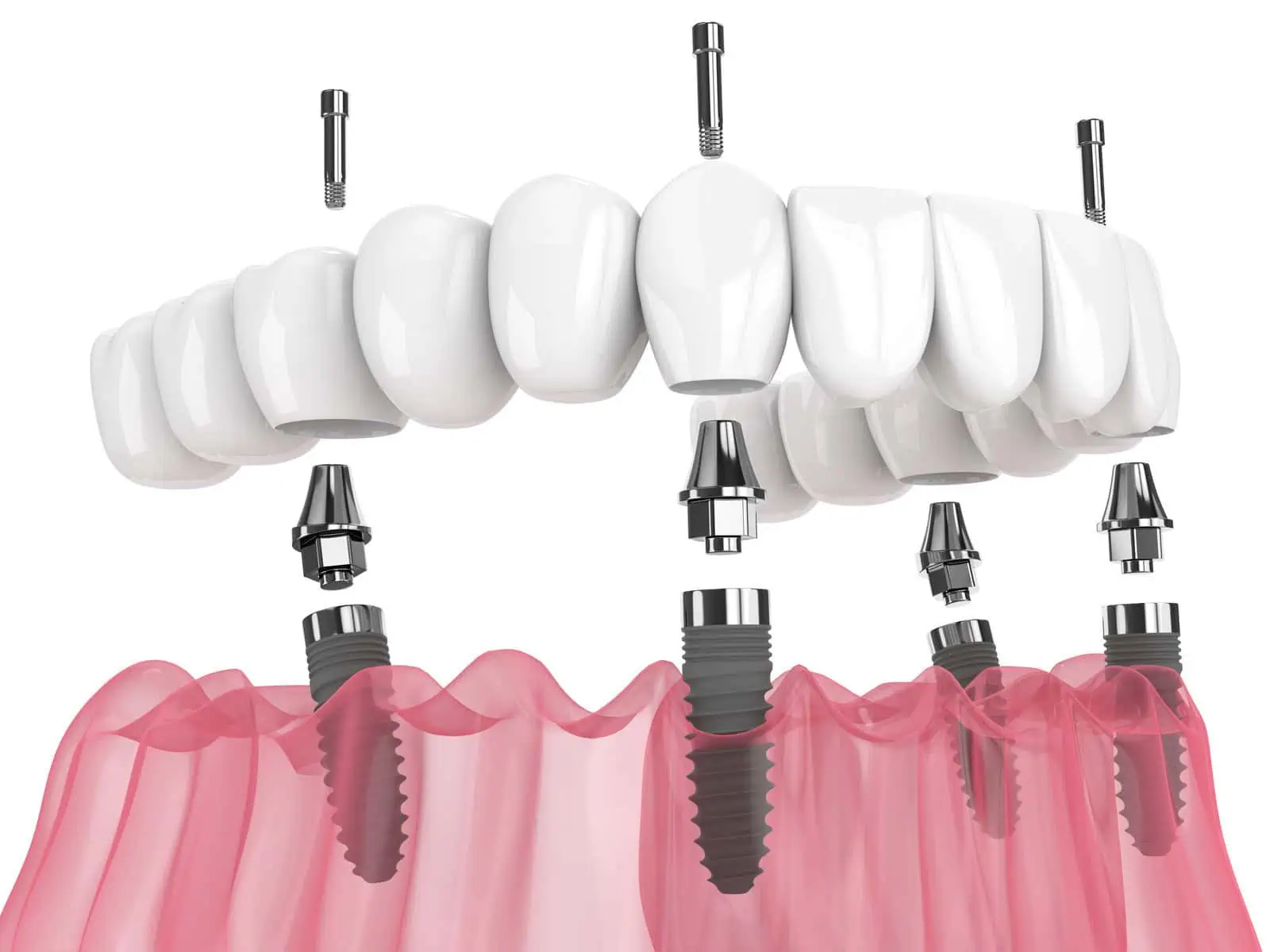
All-on-4 is a tooth replacement system that uses four strategically placed dental implants to support a full arch of replacement teeth. Unlike traditional dentures that rest on the gums, All-on-4 implants are surgically anchored into the jawbone, providing exceptional stability and preventing bone loss.
How Full-Arch Implants Work
The procedure begins with a thorough evaluation using our on-site Cone Beam CT scanner, which produces 3D images of your jawbone. This allows our oral surgery team to determine the ideal placement for each implant — two in the front of the jaw and two angled in the back to maximize contact with available bone. After the implants are placed, a custom-fabricated full-arch bridge is secured on top. In many cases, a temporary set of teeth can be attached the same day, giving you immediate function.
Are You a Candidate for All-on-4?
Good candidates are patients with significant tooth loss or failing dentures who have adequate jawbone volume to support implants. The All-on-4 technique is specifically designed to work in cases where bone loss has occurred, reducing the need for grafting. However, if your jawbone is too thin, bone grafting may be recommended first. Our team will evaluate your candidacy during a comprehensive consultation.
Patient Benefits
Benefits of Choosing Full-Arch Implants in Purcellville, VA
Restored Function
All-on-4 implants allow you to eat nearly any food with confidence — no slipping, clicking, or dietary restrictions. The fixed bridge is designed to match your natural tooth shape and color.
A Long-Term Solution
While conventional dentures require adhesives, relines, and replacement every five to seven years, All-on-4 implants are built to last. They also prevent the sunken facial appearance common with bone loss.
Teeth in a Day
In cases where your bone and health allow, we can attach a temporary prosthesis immediately after implant placement. You leave our Purcellville office with a complete set of teeth.
Advanced Treatment
Advanced Full-Arch Treatment
"Full-arch" is not a single procedure. The number of implants, where they are angled, how much bone is available, and when your final teeth are fitted all change from patient to patient. These are the variables we work through when planning a full-arch case in Purcellville.
Four implants, six, or more
All-on-4 is the most widely recognised approach, but it is not automatically the right one. Where bone volume and bite forces call for additional support — heavy grinding, a longer span, or a denser final prosthesis — an arch may be restored on six or more implants instead. The configuration follows your anatomy and how you use your teeth, not a fixed formula.
Angled placement to avoid grafting
Tilting the rear implants lets us engage the denser bone that remains toward the front of the jaw, where resorption is usually least. That is what allows many full-arch cases to proceed without extensive grafting, and it is a large part of why treatment can often be completed in a shorter overall timeline.
When grafting is still the better choice
Where bone height or width is genuinely insufficient, building the site up first produces a more predictable long-term result than forcing a graftless plan. Bone grafting and ridge augmentation can often be staged alongside extractions to keep the overall treatment time down. If your case is better served by grafting, we will explain why rather than fitting you to the quickest option.
Digitally planned, then guided
Full-arch cases are planned from an on-site 3D cone beam CT scan, which shows the bone available and the position of nerves and sinuses in three dimensions. Planning implant position and angle before surgery — rather than judging it in the moment — is what makes precise, graftless placement realistic.
From provisional teeth to the final prosthesis
The bridge you leave with on surgery day is a provisional. It restores appearance and function while the implants integrate with the bone over the following months. Once healing is complete, it is replaced with your definitive prosthesis, made to the materials and fit intended for long-term use. Knowing there are two stages — and roughly when the second happens — makes the process far easier to plan around.
Failing dentition and complex cases
Many full-arch patients are not starting from an empty jaw. They arrive with teeth that are failing from advanced gum disease, fracture, or previous extensive dentistry. Removing the remaining teeth, managing the sites, and placing implants can frequently be coordinated in a single planned surgical visit under IV sedation or general anesthesia, rather than spread across many separate appointments.
What the planning visit covers
A 3D scan of both jaws, reviewed with you on screen
How much usable bone you have, and whether grafting is needed
How many implants your arch needs, and why that number
Whether same-day provisional teeth are realistic in your case
The anesthesia plan, and what recovery looks like week by week
The full cost across both stages, and financing if you need it
Reconstruction Guide
All-on-4 vs. Traditional Dental Implants
Both All-on-4 and traditional implants replace missing teeth, but they serve different needs. The table below outlines the main differences to help you understand which option aligns with your situation.
| Feature | Full Arch Dental Implants | Traditional Dental Implants |
|---|---|---|
| Number of implants per arch | 4 | 6–8 or more |
| Best candidate | Full-arch tooth loss or failing dentures | Single or multiple missing teeth; full-arch possible |
| Treatment timeline | Same-day provisional teeth possible; full restoration in a few months | Can take 6–12 months from start to finish |
| Bone grafting typically required | Less often due to angled posterior implants | Often needed for adequate bone support |
| Cost range | Typically less than full-arch traditional implants | Higher per-implant cost but may be lower for single-tooth cases |
What Happens If You Delay Full-Arch Treatment?
Without treatment, bone loss continues to resorb (shrink) because it no longer receives stimulation from tooth roots. Over time, this bone loss can alter your facial shape, make future implant placement more challenging, and require additional grafting. Remaining teeth may shift, causing bite problems and gum damage. Quality of life also suffers — difficulty eating, speech changes, and social withdrawal are common.
Financial Information
All-on-4 Cost in Purcellville, VA — What to Expect
Key cost drivers include the number of arches treated (upper, lower, or both), the need for any preliminary procedures such as extractions or bone grafting, the materials used for your final bridge, and the complexity of your case. We provide transparent treatment plans and discuss all fees before starting. We recommend reviewing your dental insurance benefits, as some plans may cover a portion of implant surgery. For the remaining costs, we offer flexible financing options through third-party healthcare lenders. Visit our Insurance & Financing page to learn more.
Learn About Insurance & Financing
Inquiries
Frequently Asked Questions
How long does the All-on-4 procedure take?
The surgical placement of the four implants typically takes two to three hours per arch. Depending on your treatment plan, a temporary prosthesis may be attached the same day. Your total appointment time, including preparation and recovery, is usually half a day.
Is bone grafting required for All-on-4?
Not always. The angled posterior implants used in the All-on-4 technique are designed to engage stronger bone areas, often avoiding the need for grafting. However, some patients with extensive bone loss may still require a graft. Your surgeon will evaluate your 3D scan to determine the approach. Learn more about bone grafting options.
What is recovery like after full-arch implant surgery?
Most patients experience swelling, minor bruising, and manageable discomfort for a few days. We provide detailed post-operative instructions, pain medication as needed, and a soft-food diet for a short period. Many individuals return to work within one week.
How do All-on-4 implants compare to implant-supported dentures?
All-on-4 uses four implants to secure a fixed bridge that is not removable by the patient. Implant-supported dentures typically use more implants (4–6) and are often removable for cleaning. Both are excellent options; the best choice depends on your bone health, budget, and personal preference. Your surgeon will explain the differences during your consultation.
Does Loudoun Valley Oral Surgery offer sedation for implant procedures?
Yes. We offer IV sedation and general anesthesia to ensure your comfort during implant surgery. These options help even the most anxious patients feel relaxed and pain-free. Our team will review your medical history to recommend the safest sedation level for you. For more details, see our IV Sedation page.
Start Your Rebuilding Plan